
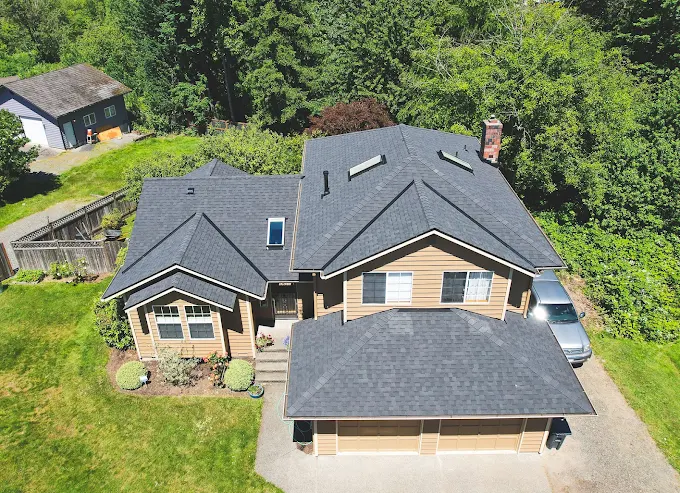
You don't need to climb on the roof to know it's in trouble. Nearly every failure we're called out for was visible from the ground, the gutters, or the attic well before the ceiling stained.
1. Granules collecting in the gutters
The sandy grit in your gutters is the protective surface of your shingles. A little after a new install is normal; handfuls from an older roof means the shingles are losing their UV protection and are near the end.
2. Curled, cupped or brittle shingle edges
Asphalt shingles lose their oils with age and begin to curl at the edges or cup in the middle. Curled edges catch wind and are the first to blow off in a storm.
3. Any shingle sitting out of line
A shingle that looks slightly lifted or offset has lost its seal. It isn't cosmetic — it's an open path for wind-driven rain, and it will get worse each storm.
4. Cracked pipe boots and rusting flashing
The rubber collars around plumbing vents are usually the first component to fail on a roof, often a decade before the shingles do. Rust streaks below a chimney or skylight mean flashing needs attention.
5. Thick moss, especially on the north slope
Thin growth can be treated. Thick mats that have lifted shingle edges have usually already let water reach the underlayment.
6. Sagging rooflines or a spongy deck
A dip along the ridge or between rafters means the decking or structure below has been wet for a long time. This is the one sign that should never wait.
7. Attic stains, damp insulation or daylight
Dark rings on the underside of the decking are old leaks; wet, compressed insulation is an active one. Daylight around a vent or chimney is an obvious entry point for water.
Repair or replace?
One failed boot or a wind-damaged section on an otherwise sound roof is a repair. Widespread granule loss, curling across multiple slopes, or soft decking on a roof past twenty years is a replacement — patching it means paying twice. We photograph what we find and tell you which one it is.
What we look for around Tacoma, Puyallup and Lakewood
Pierce County has a wide mix of housing: older homes in Tacoma's north end and hilltop neighborhoods, and large subdivisions in Puyallup and Lakewood built in the 1990s and 2000s. Many of those newer subdivision roofs are now reaching the age where curling shingles, granule loss and worn pipe boots show up. Spotting the signs early is usually the difference between a repair and a replacement.
Serving Tacoma, Puyallup, Lakewood and nearby communities. Call (425) 783-9543.