
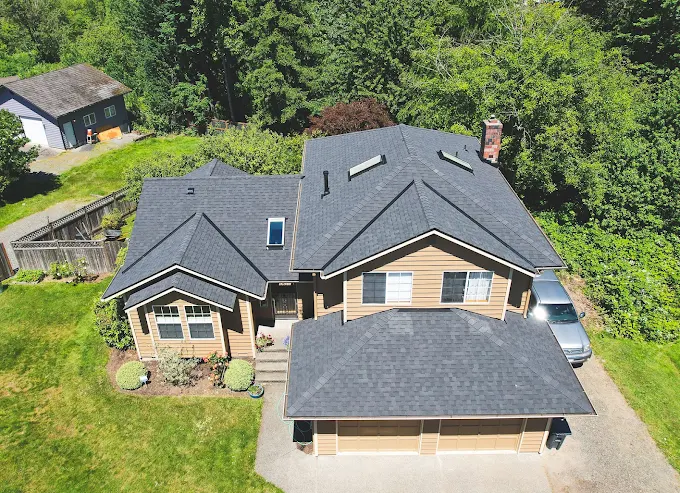
Western Washington doesn't get the hail that drives roof claims in other parts of the country. What we get instead is an atmospheric river: a narrow band of subtropical moisture that parks over the region and delivers days of rain, often with strong sustained wind behind it. That combination finds weaknesses a normal shower never would.
Wind-driven rain gets in where gravity alone can't
A roof sheds water falling straight down. When wind pushes rain sideways and upward it goes under shingle edges, behind siding at the roof-to-wall junction, and through vent louvers. This is why a roof can perform fine all autumn and then leak during one storm — the weak point only matters when the rain arrives horizontally.
Sustained wind lifts before it tears
Ridge caps and the first courses at eaves and rakes take the most uplift. Often a storm doesn't remove shingles outright; it breaks the thermal seal so they sit loose. The roof looks intact from the street, and the next storm takes the shingle off entirely. After a wind event, look for shingles sitting slightly proud of their neighbours and granules washed into the gutters.
Falling limbs are the bigger local risk
Between mature firs and saturated ground, limb strikes and whole tree falls cause more of our winter emergency calls than wind alone. A limb impact can fracture decking under intact-looking shingles, so it's worth having a strike inspected even if there's no visible hole.
What to do with an active leak
Contain it first: a bucket, and a small hole poked in a bulging ceiling to let trapped water drain in one place rather than bringing down a whole section of drywall. Photograph everything before cleanup — it matters for an insurance claim. Then call for emergency tarping. Don't go on a wet roof in wind; that's what we're equipped for.
After the storm passes
Walk the perimeter and look for shingle pieces or metal in the yard, dented or detached gutters, displaced ridge caps, and staining at ceilings or in the attic. Document the date of the storm — insurers care about tying damage to a specific weather event.
Storms in Whatcom, Skagit and Snohomish counties
Bellingham and the north county can get strong outflow winds from the Fraser River valley in winter, and the open Skagit flats around Burlington give wind little to slow it down. Everett and the Snohomish County coastline take the brunt of southwest storms off Puget Sound. After a big storm, check for missing ridge caps, lifted shingle tabs and fallen branches from the ground, and call before climbing a wet roof.
Serving Bellingham, Burlington, Everett and nearby communities. Call (425) 783-9543.
Local to this topic: Whatcom County storm damage repair.