
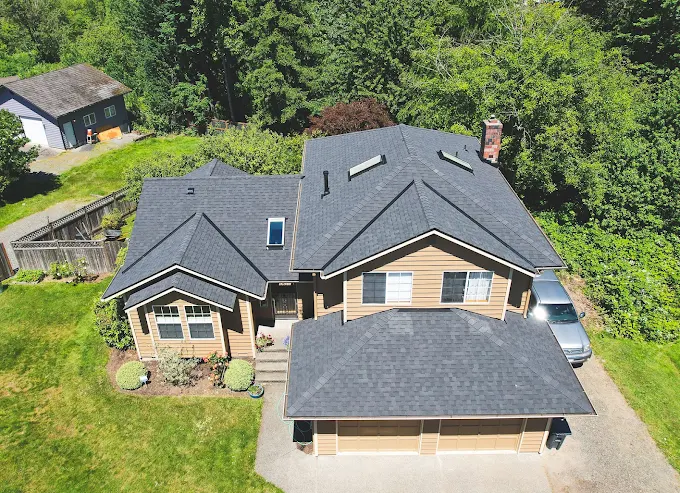
Almost every roof west of the Cascades grows moss eventually. Mild winters, constant damp and heavy fir cover give it everything it needs. On its own, a thin green fuzz isn't an emergency — but left alone for a few seasons it will shorten the life of an asphalt roof considerably.
What moss actually does to a roof
Moss holds water against the shingle surface long after the rain stops. As it thickens it creeps under the shingle course and lifts the edge, letting water travel sideways instead of running off. That water reaches the underlayment and, eventually, the decking. The second problem is weight: saturated moss on a north-facing slope adds load and keeps the surface permanently wet, which accelerates granule loss.
Never pressure-wash an asphalt roof
This is the single most common way homeowners damage a roof they were trying to save. A pressure washer strips the protective granules off asphalt shingles and drives water up under the courses. What's left looks clean for a season and then fails early. Cedar and tile have their own limits too. The safe approach is a gentle treatment followed by soft brushing, working downslope, and letting the next rains rinse the rest away.
Keeping it from coming back
Moss returns unless the conditions change. Trimming overhanging limbs to let light and air reach the roof does more than any single treatment. Zinc or copper strips installed at the ridge release a small amount of metal in runoff that suppresses regrowth on the slope below. Keeping gutters and valleys clear of needles stops the damp debris beds where moss establishes first.
When moss means the roof is past saving
If shingle edges are curled and brittle, granules are collecting in the gutters by the handful, or the decking feels soft underfoot, cleaning is money spent on a roof that's already at the end of its life. We'll tell you plainly which situation you're in, with photos, before you spend anything.
Moss in Everett, Bellingham and the Skagit Valley
North of Seattle, tall fir and cedar stands shade many neighborhoods, and marine air keeps roofs damp for much of the year. North-facing slopes under trees in Everett, Bellingham and Mount Vernon are usually the first places moss takes hold, especially on older composition roofs from the 1980s and 1990s. Trimming back limbs and adding zinc strips at the ridge help most on these shaded lots.
Serving Everett, Bellingham, Mount Vernon and nearby communities. Call (425) 783-9543.
Local to this topic: Snohomish County roof repair.